



You have technical conviction. The business case needs work.
You know the technology is differentiated. What is less clear is who the first customer is, what product they are buying, at what price, and how the business model supports scale.
Hatch works with university and corporate teams preparing to spin out — building the commercial foundation, engineering-to-product logic, business model, and investor narrative that a serious spinout decision requires. We help you answer the questions you will be asked, before you are asked them.
We work with pre-spinout teams to shape commercially credible businesses before critical funding and growth decisions are made. By validating markets, refining business models, and translating complex engineering into investor-ready propositions, we help ensure promising technologies are positioned for long-term commercial success.
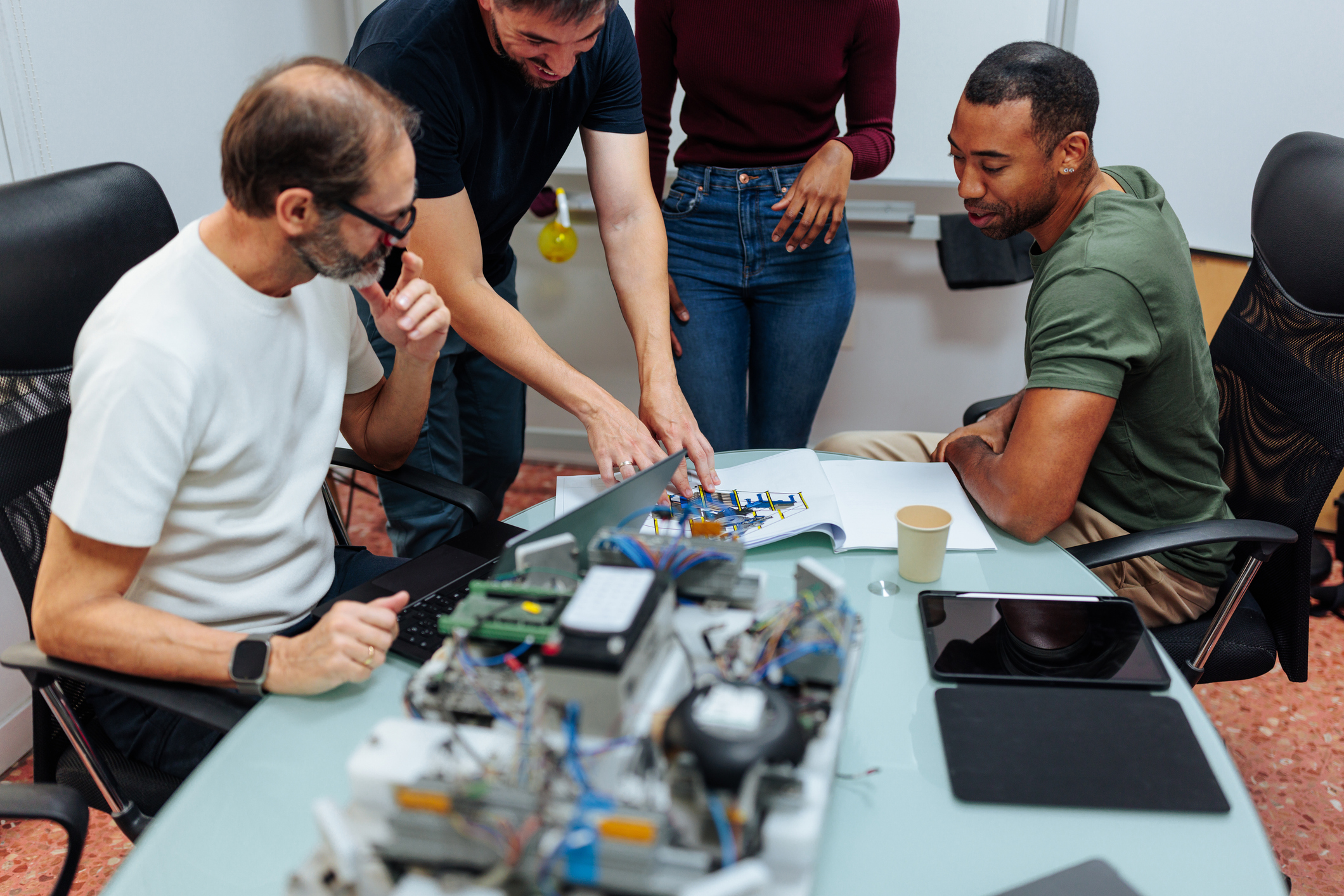
Assessing technologies against real market demand, customer economics, and commercial viability to identify the strongest opportunities and most defensible market entry points.
You know the technology is differentiated. What is less clear is who the first customer is, what product they are buying, at what price, and how the business model supports scale.

Many pre-spinout ventures discover, on closer examination, that the market they assumed or the business model they scoped will not actually fund. Finding that out before incorporation is significantly better than finding it out after.

A polished pitch deck is not enough. You need a commercial case that investors can stress-test, a route to market that can be defended, and an engineering roadmap that maps to product rather than to research milestones.
By working directly with researchers and university-led ventures, we turn complex concepts into actionable development plans. We bring structure to the innovation process, helping early-stage technologies evolve into products with clear direction and purpose. From validating assumptions to supporting production planning, we help create a smoother path from research to real-world application.

We bring commercialisation discipline to the pre-spinout phase. That means screening candidate applications against real customer economics and naming a defensible beachhead; building the business model — including where the venture should own value and where it should partner; preparing the full suite of investor-facing materials (memorandum, market sizing, pitch deck, risk register); and — where the existing plan will not lead to a fundable business — saying so, and helping you build one that will.
We have worked with teams inside universities and inside established companies. The shape of the work is similar in both cases; the institutional navigation is different, and we understand both.
Related case study
A UK university enterprise office commissioned Hatch Oxford to take a research programme — a novel industrial robotics technology aimed at an emerging circular-economy application — through to a spin-out-ready commercial proposition. Phase 1 characterised the technology stack, segmented the adopter market, mapped the competitive landscape, and recommended a specific commercial form: a spin-out positioned as a systems integrator rather than a hardware manufacturer, with the fastest-moving adopter segment as the beachhead. Phase 2 — spin-out formation and readiness — is now live. Engagement and findings remain commercially confidential.
We help innovators, researchers, and businesses turn ideas into commercially viable products through a blend of engineering expertise, market insight, and hands-on delivery.
We help innovators, researchers, and businesses turn ideas into commercially viable products through a blend of engineering expertise, market insight, and hands-on delivery.
Deeptech commercialisation decisions — which application to pursue, which partner to engage, what to own and what to outsource — cannot be made well without engineering judgement, and engineering decisions cannot be made well without commercial context. Most advisory firms separate the two: a business consultancy handles the market case, a technical consultancy handles the product. The seams between them are where ventures lose time and money. At Hatch, both capabilities sit inside the same firm and are applied to the same problem at the same time. That is not a marketing line; it is the operating model.
Hatch works primarily on fee-based engagements. Equity participation is possible on a selective basis where the work warrants it and the venture is at a stage where equity can be meaningfully priced, but it is the exception rather than the default. We are transparent about fee structure up front — no retainer creep, no undefined scope. Every engagement starts with a named set of outcomes and a named set of deliverables.
Between the two co-founders, Hatch brings more than thirty years of engineering experience across clean energy, advanced materials, robotics in the nuclear industry, motorsport, and industrial manufacturing — delivered inside startups, scale-ups, and established industrials. We list sectors we have actually worked in rather than sectors we could theoretically cover; we turn down engagements where we cannot credibly add value. If your venture sits in a field we have not named, tell us what it is and we will be honest about whether we are the right fit.
Hatch operates on both sides of the Atlantic — from Oxford in the United Kingdom and from Grand Rapids, Michigan in the United States. We work with UK universities including Oxford, Birmingham, Newcastle, and Strathclyde, and with US partners including the University of Michigan and Michigan State University. Engagements can be run remotely, on-site, or a combination. The transatlantic footprint is part of the firm's operating model — it lets us help UK-origin ventures navigate US markets and US-origin ventures navigate UK funding routes.
Hatch is likely a good fit if: your technology originates from research (university, national lab, or corporate R&D); you are between early technical conviction and Series A; you need both engineering and commercial judgement applied to the same problem; and you would rather work directly with experienced co-founders than with an account team. Hatch is probably not the right fit if: you need a large delivery team, a pure software startup advisor, general management consulting, or a firm that will confirm whatever plan is already in front of it. In either case, the fastest way to find out is to talk to us.
Use the "Let's collaborate" form on this site and select the option that best describes you — researcher, TTO, pre-spinout, spinout, or something else. You can also email us directly at the address in the footer. Either way, one of the co-founders will respond personally.

Innovate UK has changed direction. Chasing a grant with a strong technical story is no longer enough. Under the new strategy, the best applications start long before the form is opened — and read like business cases, not project briefs.

In most deeptech ventures, engineering and commercial decisions are made by different people, at different times, in different rooms. That split is where value leaks — and the ventures that reach Series A in defensible shape are the ones that never let it open in the first place.

Most university spinouts do not fail because the underlying science is weak. They fail because the systems surrounding them are designed to generate ideas, not to sustain industrial businesses. The "valley of death" is, in practice, a gap in ownership — and closing it requires more than better advice.
Partner with Hatch to bring clarity, momentum, and commercial success to your innovation.